Table of Contents
Welcome to the January Plank challenge, a simple yet effective daily challenge that will improve your core strength and endurance throughout January.
Whatever your fitness resolutions for the new year, add this challenge to the mix for daily inspiration and to keep you focused. This challenge only takes a short time each day; furthermore, my challenges are designed not only to challenge you but also to create healthy, active habits you can continue. You’ll soon learn you don’t need to invest vast amounts of time into exercise; however, you do need to be consistent.
There are three levels to choose from in this challenge, so you can pick the one that best fits your current fitness level. Each level features a different plank variation and a progressively longer hold time.
What is the January Plank Challenge?
The January Plank challenge is a fitness challenge that involves doing the plank exercise daily throughout January. The plank is an exercise that involves holding your body in a straight, stationary position while resting on your forearms and toes. It is an effective way to strengthen and tone your core, including your abs, back, and hips. It can also improve your endurance and overall physical fitness. To participate in the January Plank challenge, you need to do the plank exercise every day for the target duration.
As always, when exercising, it is essential to listen to your body and only do as much as you feel comfortable with. The January Plank challenge is a simple and effective way to improve your core strength and endurance, and can be a great way to kick off the new year with a healthy and active lifestyle.
Are you ready to start your fitness plans for the new year?
Missed the January Plank Challenge?
Don’t worry, get started today with the 28 Day Plank Challenge.
What is a plank?
The plank is a bodyweight exercise that involves holding your body in a straight, stationary position while resting on your forearms and toes. It is a popular exercise for strengthening and toning your core, including your abs, back, and hips. A staple of fitness, it is often used during fitness tests and assessments.
Often called a prone bridge, it is a simple static exercise that works every part of your core and your whole body as you maintain a rigid position.
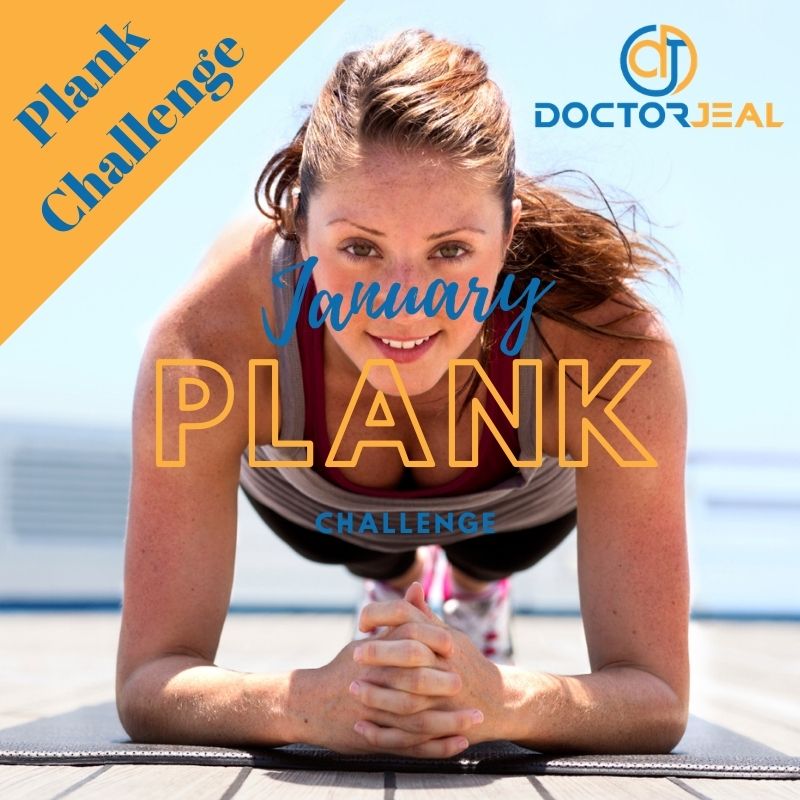
Visually, the plank is a bridge supported on your toes and forearms, a straight line from your heels to your shoulders. As a result, it looks so simple that you’d think it was easy, but it is not. Consequently, you’ll find the plank in almost any fitness programme, because it is highly effective and targets a fundamental muscle group: your core.

Plank Fitness Test
The January Plank challenge is progressive, and you should notice some gains throughout the month. To start, test your current core strength with a Plank test. This simple test will give you an idea of where you are now, which you can compare with when you conduct the same test at the end of the challenge. The result of the test will help you choose the plank variation to do during the challenge.
To conduct the test:
- Have a stopwatch ready, or have a friend with one.
- Get into the plank position.
- Hold the plank for as long as you can.
- Stop the test when you fail or when 2 minutes have passed.
Choose the Plank variation based on your initial Plank Test result
- Under 30 seconds – Choose the Beginner variation (Half Plank).
- 30 seconds up to 1 minute 30 seconds – Choose the Regular plank on forearms or with straight arms.
- 1 minute 30 seconds and above – Choose the Plank/Up Down variation for a dynamic plank. Alternatively, you could use an unstable platform such as a BOSU, Balance Pod or Fitness Ball and place your feet upon it, creating a more demanding static Plank exercise. Or choose from these 28 Plank Variations
Test your progress with a follow-up Plank Test at the end of the month
After a month of regular planking, you should be feeling stronger with more endurance in your core and stabilising muscles. To find out how you have improved, repeat the test you conducted at the start of the month. The test should be conducted under precisely the same conditions, with the same plank variation, etc.
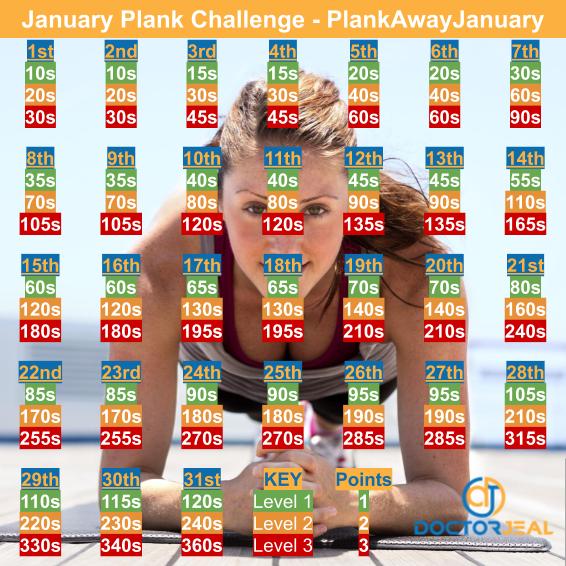
Plank Challenge Target Guide #Plankawaychallenge

Scoring the Plank Challenge
The plank challenge is split into three levels, and you can track your progress. You don’t need to keep to one level; you can mix & match and go up or down a level. Each level has a score. Use the free-scoring sheet available for download below to track your progress and tally your total score for the month
| TARGET LEVEL | POINTS | EXERCISE LEVEL | POINTS |
| Level 1 | 1 point | Easy (Half Plank) | + 1 point |
| Level 2 | 2 points | Moderate (Full Blank) | + 2 points |
| Level 3 | 3 points | Advanced (UP/Downs) | + 3 points |
🧮 Scoring Formula
📊 Example Scenarios
| Day | Target Level | Exercise Variation | Points (Target) | Points (Variation) | Total Daily Score |
|---|---|---|---|---|---|
| 1 | Level 1 | Half Plank | 1 | 1 | 2 |
| 2 | Level 2 | Full Plank | 2 | 2 | 4 |
| 3 | Level 3 | Up/Downs | 3 | 3 | 6 |
| 4 | Level 2 | Half Plank | 2 | 1 | 3 |
| 5 | Level 3 | Full Plank | 3 | 2 | 5 |

January Plank Exercise Challenge Scoring Sheet (PlankAwayJanuary) 80 KB 20 downloads
Download the January Plank Challenge scoring sheet and score your challenge every…Suggested Equipment
- GymBoss (sponsored link via Amazon.co.uk)
- Exercise Matt (sponsored link via Amazon.co.uk)
GymBoss, the Number One Tool you Need to Time your HIIT Intervals
Programme Design
I have designed this challenge as a progressive, ascending pyramid, with simple turns; each day is equal to or more challenging than the last. The challenge progresses in small steps, helping you get stronger as you go through the month. The challenge has two-day steps where we keep to the same target for two days (we can call this acclimatisation if you like). It’s all about getting you up to your target time at the end of the month, in a safe, effective, and progressive manner.
One or more columns doesn't have a header. Please enter headers for all columns in order to proceed.
Ready to commit?
Tweet this and add some accountability, and why not get some friends to join you, too?
Did you know? You are much more likely to achieve your goals if you share them with your friends and also get them to join you.
I'm doing #PlankAwayJanuary, and you can join me for free—a daily Plank Challenge to keep me motivated. Share on XThe Plank Exercise
A plank exercise is a bodyweight exercise that targets the core, including the abdominal, lower back, and pelvic muscles. Planks are often included in workouts to improve overall core strength and stability.
There are three variations of the plank designed for the beginner, intermediate and advanced levels of fitness, which you can choose from for this plank challenge.
- Beginner – Half Plank
- Intermediate – Forearm or Straight Arm Plank
- Advanced – Plank Up Downs
Want more? Check out my 28 Plank Variations
Key Points
- Keep neutral spine alignment
- Maintain a straight line through shoulders, hips, knees & ankles
- Maintain abdominal tension
- Remember to breathe
Plank Challenge Variation at level 1
Beginner – Half Plank (from knees)
The beginner plank variation for this plank challenge features a modified plank or a half plank suitable for beginners and those new to exercise. It is a less intense version of the plank exercise. Yet a daily commitment to the plank challenge will enable you to improve your core strength and stability.
A half plank exercise, also known as a modified plank, is a variation of the traditional plank exercise that targets the muscles in the core, including the abdominal muscles, obliques, and lower back muscles. It is a great exercise for those who are new to planks or who want to modify the traditional plank to make it easier or more challenging.
To do a half plank exercise, start by getting into a plank position with your feet side by side and your elbow resting on the ground. Your body should be in a straight line from your head to your feet.
Plank Challenge Variation at level 2
Regular – Forearm Plank or Straight Arm Plank
To do a plank exercise, you start in a push-up position with your hands shoulder-width apart and your feet hip-width apart. Your body should be straight and tense, with your weight balanced evenly between your hands and feet.
Plank Challenge Variation at level 3
Plank Up Downs
The Plank Up/Down exercise is a dynamic variation of a traditional plank exercise where you will alternate between a forearm plank and a straight-arm plank. This is achieved by moving one arm at a time from the forearm plank position to the straight arm plank position followed by the other arm and returning back to the start position by returning one arm at a time back to the forearm plank position.


2 comments
[…] Day 1 […]
[…] January Plank Challenge (PlankAwayJanuary) […]